
-
 USD
Home
/
cjc5mg+ipa 5mg/10mg 10vials
cjc5mg+ipa 5mg/10mg 10vials
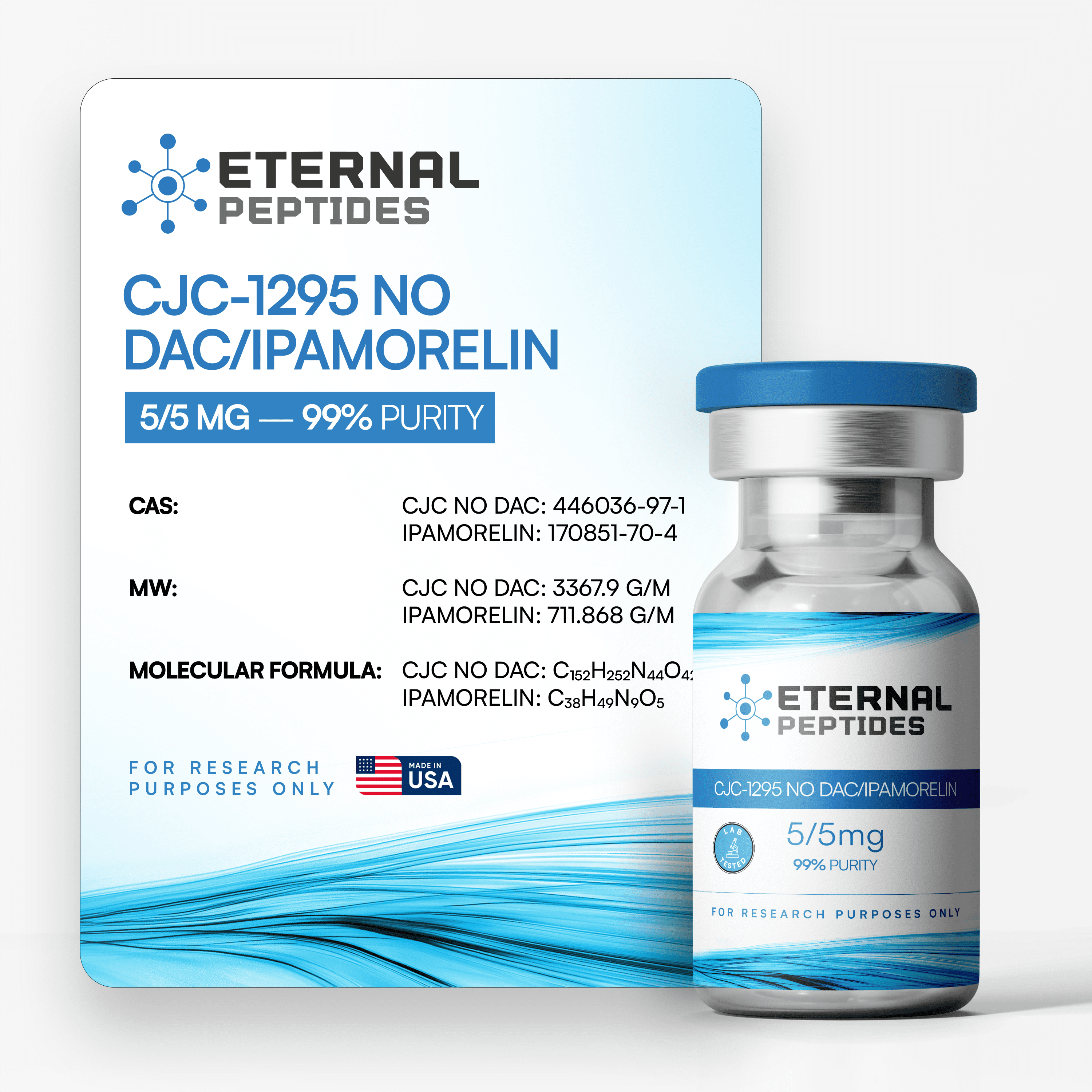
A synergistic research blend combining CJC-1295 without DAC (a GHRH analog) and Ipamorelin (a selective growth hormone-releasing peptide). Designed for studies on pulsatile GH release, body composition modulation, and IGF-1 axis signaling. 5mg/5mg lyophilized powder, high quality.
Quantity
-
Detail
What is CJC-1295/Ipamorelin Blend?
CJC-1295/Ipamorelin Blend is a research-grade combination peptide containing 5 mg of CJC-1295 (no DAC), also known as Modified GRF(1-29), and 5 mg of Ipamorelin in a single lyophilized vial. This formulation brings together two of the most extensively studied growth hormone (GH) secretagogues, each operating through a distinct receptor pathway, to facilitate synergistic amplification of GH release in experimental models.
CJC-1295 no DAC is a 29-amino-acid synthetic analog of endogenous growth hormone-releasing hormone (GHRH). Its molecular formula is C152H252N44O42, with a molecular weight of approximately 3,367.9 Da. It features four key amino acid substitutions at positions 2 (D-Ala), 8 (Gln), 15 (Ala), and 27 (Leu) relative to native GRF(1-29), which confer enhanced resistance to enzymatic degradation by dipeptidyl peptidase-IV (DPP-IV) and other proteases (Jetté et al., 2005).
Ipamorelin is a synthetic pentapeptide with the sequence Aib-His-D-2-Nal-D-Phe-Lys-NH2. Its molecular formula is C38H49N9O5, with a molecular weight of approximately 711.85 Da. Designated NNC 26-0161 during development, ipamorelin was characterized as the first selective growth hormone secretagogue (GHS) — meaning it stimulates GH release without significantly affecting adrenocorticotropic hormone (ACTH), cortisol, or prolactin levels (Raun et al., 1998). The combined molecular weight of this blend is approximately 4,079.8 Da.
Mechanism of Action
The CJC-1295/Ipamorelin Blend derives its research value from the complementary dual-pathway activation of pituitary somatotroph cells. Each component engages a separate receptor system, and when administered together, the two peptides produce a synergistic GH response that exceeds the sum of their individual effects.
CJC-1295 (Modified GRF 1-29): GHRH Receptor Pathway
CJC-1295 no DAC binds to the growth hormone-releasing hormone receptor (GHRH-R), a G protein-coupled receptor (GPCR) expressed on anterior pituitary somatotrophs. Upon receptor engagement, CJC-1295 activates adenylyl cyclase via the Gαs subunit, increasing intracellular cyclic adenosine monophosphate (cAMP) concentrations. This cAMP elevation activates protein kinase A (PKA), which phosphorylates downstream targets including the transcription factor CREB (cAMP response element-binding protein). The net effect is both an acute release of stored GH granules and longer-term upregulation of GH gene transcription (Teichman et al., 2006). Research in GHRH knockout (GHRHKO) mice demonstrated that daily CJC-1295 administration restored normal growth parameters and body composition, confirming its action through the GHRH-R pathway (Alba et al., 2006).
Ipamorelin: GHS Receptor (Ghrelin Receptor) Pathway
Ipamorelin binds to the growth hormone secretagogue receptor type 1a (GHS-R1a), the same receptor targeted by the endogenous hormone ghrelin. Activation of GHS-R1a triggers the phospholipase C (PLC)/inositol trisphosphate (IP3) signaling cascade, leading to the release of calcium from intracellular stores and a subsequent influx of extracellular calcium. This calcium surge induces rapid exocytosis of GH vesicles. Importantly, Raun et al. (1998) demonstrated that ipamorelin displays a selectivity profile for GH release comparable to that of GHRH itself — it does not significantly elevate ACTH, cortisol, follicle-stimulating hormone (FSH), luteinizing hormone (LH), prolactin (PRL), or thyroid-stimulating hormone (TSH), even at doses more than 200-fold above the ED50 for GH release (Raun et al., 1998).
Synergistic Amplification
The simultaneous engagement of both the GHRH-R (via CJC-1295) and GHS-R1a (via Ipamorelin) produces a well-documented synergistic GH release. Bowers et al. (1991) were among the first to describe this phenomenon, demonstrating that combined GHRH and GHRP administration resulted in dramatically amplified GH secretion that could not be explained by simple addition of the two pathways (Bowers et al., 1991). Hanew et al. (1994) confirmed in clinical subjects that GHRP administered with GHRH produced synergistically enhanced plasma GH responses (Hanew et al., 1994). This synergy arises because GHRH provides the sustained cAMP-dependent “priming” signal while the GHRP pathway delivers the acute calcium-dependent “trigger” for GH exocytosis. Together, they maximize both the amplitude and duration of GH pulsatility.
Research Applications
The CJC-1295/Ipamorelin Blend has attracted substantial research interest across multiple domains due to its potent and selective amplification of the GH/IGF-1 axis. Below are the primary areas of investigation.
Growth Hormone Optimization and GH/IGF-1 Axis Research
The primary application of this blend in research settings is the study of growth hormone releasing peptides and their capacity to elevate endogenous GH and insulin-like growth factor 1 (IGF-1). Teichman et al. (2006) demonstrated that CJC-1295 alone produced dose-dependent increases in mean plasma GH concentrations by 2- to 10-fold and IGF-1 concentrations by 1.5- to 3-fold in healthy subjects (Teichman et al., 2006). When combined with a GHS-R1a agonist such as Ipamorelin, research protocols can investigate whether the synergistic GH response translates into proportionally greater IGF-1 elevations and downstream anabolic signaling. Sackmann-Sala et al. (2009) further showed that CJC-1295-mediated GH/IGF-1 axis activation produced measurable changes in serum protein profiles, suggesting broad metabolic effects beyond simple GH elevation (Sackmann-Sala et al., 2009).
Body Composition and Metabolic Research
The GH/IGF-1 axis plays a central role in the regulation of lean body mass and adipose tissue metabolism. Studies on GH secretagogues indicate their potential to influence body composition parameters in experimental models. Alba et al. (2006) showed that CJC-1295 treatment maintained normal body composition in GHRH-deficient mice, including the preservation of lean mass and limitation of fat accumulation (Alba et al., 2006). The combination of a GHRH analog with a GHRP in peptide stack protocols allows researchers to evaluate whether synergistic GH output offers advantages in body composition endpoints compared to single-agent approaches. Investigations exploring peptides for weight loss research frequently incorporate this blend due to its dual-mechanism GH amplification.
Bone and Skeletal Tissue Research
Ipamorelin has been independently studied for its effects on skeletal tissue. Johansen et al. (1999) demonstrated that ipamorelin dose-dependently increased longitudinal bone growth rate in adult female rats, from 42 μm/day in vehicle controls to 52 μm/day at the highest dose (Johansen et al., 1999). Svensson et al. (2000) showed that 12 weeks of continuous ipamorelin administration increased total tibial and vertebral bone mineral content (BMC) in adult female rats as measured by dual-energy X-ray absorptiometry (DXA) (Svensson et al., 2000). Additionally, Andersen et al. (2001) found that ipamorelin counteracted glucocorticoid-induced decreases in bone formation markers in adult rats (Andersen et al., 2001). These findings make the blend valuable for research investigating peptides for joint and bone support.
Anti-Aging and Age-Related GH Decline Research
Endogenous GH secretion declines progressively with age, a phenomenon known as somatopause. Researchers studying peptides for anti-aging research use the CJC-1295/Ipamorelin Blend to investigate whether restoring pulsatile GH secretion through dual-pathway stimulation can counteract age-associated physiological changes. Because both peptides work through endogenous feedback mechanisms rather than introducing exogenous GH, research protocols can examine whether this approach maintains more physiological GH pulsatility patterns compared to direct GH administration.
Gastrointestinal Motility Research
Ipamorelin’s activity at the GHS-R1a receptor, which is widely distributed in the gastrointestinal (GI) tract, has led to investigations of its prokinetic effects. Venkova et al. (2016) demonstrated that ipamorelin accelerated gastric emptying in a rodent model of postoperative ileus, highlighting its potential as a GI motility agent acting through ghrelin receptor pathways (Venkova et al., 2016). This application is distinct from the GH-releasing properties and expands the research utility of the blend.
Published Research Studies
The following peer-reviewed studies form the core evidence base supporting research with the CJC-1295/Ipamorelin Blend and its individual components.
Teichman et al. (2006) – CJC-1295 in Healthy Adults
In a pair of randomized, placebo-controlled, double-blind ascending dose trials, Teichman et al. (2006) evaluated CJC-1295 in healthy subjects aged 21–61 years. Subcutaneous CJC-1295 produced dose-dependent GH increases of 2- to 10-fold sustained for 6 or more days, and IGF-1 increases of 1.5- to 3-fold lasting 9–11 days after a single injection. Multiple doses demonstrated a cumulative effect with IGF-1 remaining elevated above baseline for up to 28 days. Published in the Journal of Clinical Endocrinology & Metabolism.
Raun et al. (1998) – Ipamorelin Selectivity Profile
Raun et al. (1998) characterized ipamorelin as the first selective GH secretagogue. In both rat pituitary cell cultures and conscious swine, ipamorelin released GH with potency and efficacy comparable to GHRP-6 (ED50 = 2.3 nmol/kg in swine). Crucially, ipamorelin did not affect ACTH or cortisol levels even at doses exceeding the GH ED50 by more than 200-fold, establishing its unique selectivity. Published in the European Journal of Endocrinology.
Bowers et al. (1991) – GHRH/GHRP Synergy
Bowers et al. (1991) provided foundational evidence for the synergistic interaction between GHRH and growth hormone-releasing peptides. The study demonstrated that the combined GH release from GHRP plus GHRH exceeded what could be explained by additive effects, somatostatin inhibition, or GHRH stimulation alone, establishing the principle of complementary dual-pathway activation. Published in Endocrinology.
Svensson et al. (2000) – Ipamorelin and Bone Mineral Content
Svensson et al. (2000) administered ipamorelin (0.5 mg/kg/day) via subcutaneous osmotic minipumps for 12 weeks in adult female rats. DXA measurements revealed significant increases in total tibial and vertebral BMC. In vitro pQCT analysis showed that the cortical BMC increase was attributable to increased cross-sectional bone area rather than volumetric density changes. Published in the Journal of Endocrinology.
Alba et al. (2006) – CJC-1295 in GHRH Knockout Mice
Alba et al. (2006) demonstrated that once-daily administration of CJC-1295 normalized growth and body composition in GHRH knockout mice. The study confirmed that CJC-1295 acts specifically through the GHRH receptor pathway and that sustained receptor activation can restore normal physiological parameters. Published in the American Journal of Physiology – Endocrinology and Metabolism.
Dosage Protocols in Research
Note: The following information reflects dosages reported in published preclinical and clinical research studies. All data is presented for research purposes only.
CJC-1295 (no DAC) Dosing in Published Studies
In the clinical trial by Teichman et al. (2006), CJC-1295 was administered subcutaneously at doses ranging from 30 to 60 μg/kg in single and multiple dose protocols (Teichman et al., 2006). The 30 and 60 μg/kg doses were noted as being well tolerated with sustained GH/IGF-1 elevation. In the GHRHKO mouse model, Alba et al. (2006) used daily subcutaneous injections to normalize growth parameters (Alba et al., 2006).
Ipamorelin Dosing in Published Studies
Johansen et al. (1999) administered ipamorelin at 18, 90, and 450 μg/day (divided into three daily subcutaneous injections) over 15 days in female rats, with dose-dependent increases in longitudinal bone growth rate (Johansen et al., 1999). Svensson et al. (2000) used continuous infusion at 0.5 mg/kg/day via osmotic minipumps over 12 weeks (Svensson et al., 2000). In the selectivity study by Raun et al. (1998), the ED50 for GH release was 80 nmol/kg in anaesthetized rats and 2.3 nmol/kg in conscious swine.
Reconstitution Guidelines for Research
This blend is supplied as a lyophilized powder containing 5 mg CJC-1295 (no DAC) and 5 mg Ipamorelin. For reconstitution, add bacteriostatic water (0.9% benzyl alcohol) slowly along the inside wall of the vial. A common research reconstitution volume is 2 mL of bacteriostatic water, yielding a concentration of 2.5 mg/mL for each peptide component. Allow the powder to dissolve completely without shaking — gentle swirling is acceptable. For detailed reconstitution instructions, refer to our guide on how to reconstitute peptides.
Storage and Handling
Proper storage is essential to maintain the integrity and biological activity of the CJC-1295/Ipamorelin Blend. As a lyophilized peptide product, it should be stored according to the following guidelines to ensure consistency across research protocols.
Before reconstitution: Store the sealed vial at -20°C for long-term storage (up to 24 months) or at 2–8°C (standard refrigeration) for short-term storage of up to 3 months. Keep the vial in its original packaging, protected from light and moisture. Do not expose to repeated freeze-thaw cycles.
After reconstitution: Store the reconstituted solution at 2–8°C (refrigerated). Use reconstituted peptide within 4–6 weeks for optimal potency. Do not freeze reconstituted solutions, as this may cause degradation or aggregation of the peptide chains. Use sterile technique for all handling to prevent microbial contamination.
General handling: Avoid vigorous shaking, which can cause peptide denaturation and foaming. Protect from direct sunlight and UV exposure at all times. Use insulin-grade syringes to minimize dead volume loss during aspiration.
-
Customer ReviewsNo comments